Download our Trade Union Reforms Resource Pack for practical guidance on union recognition, workplace access rights, employer obligations, and preparing for Employment Rights Act changes.
DownloadDownload
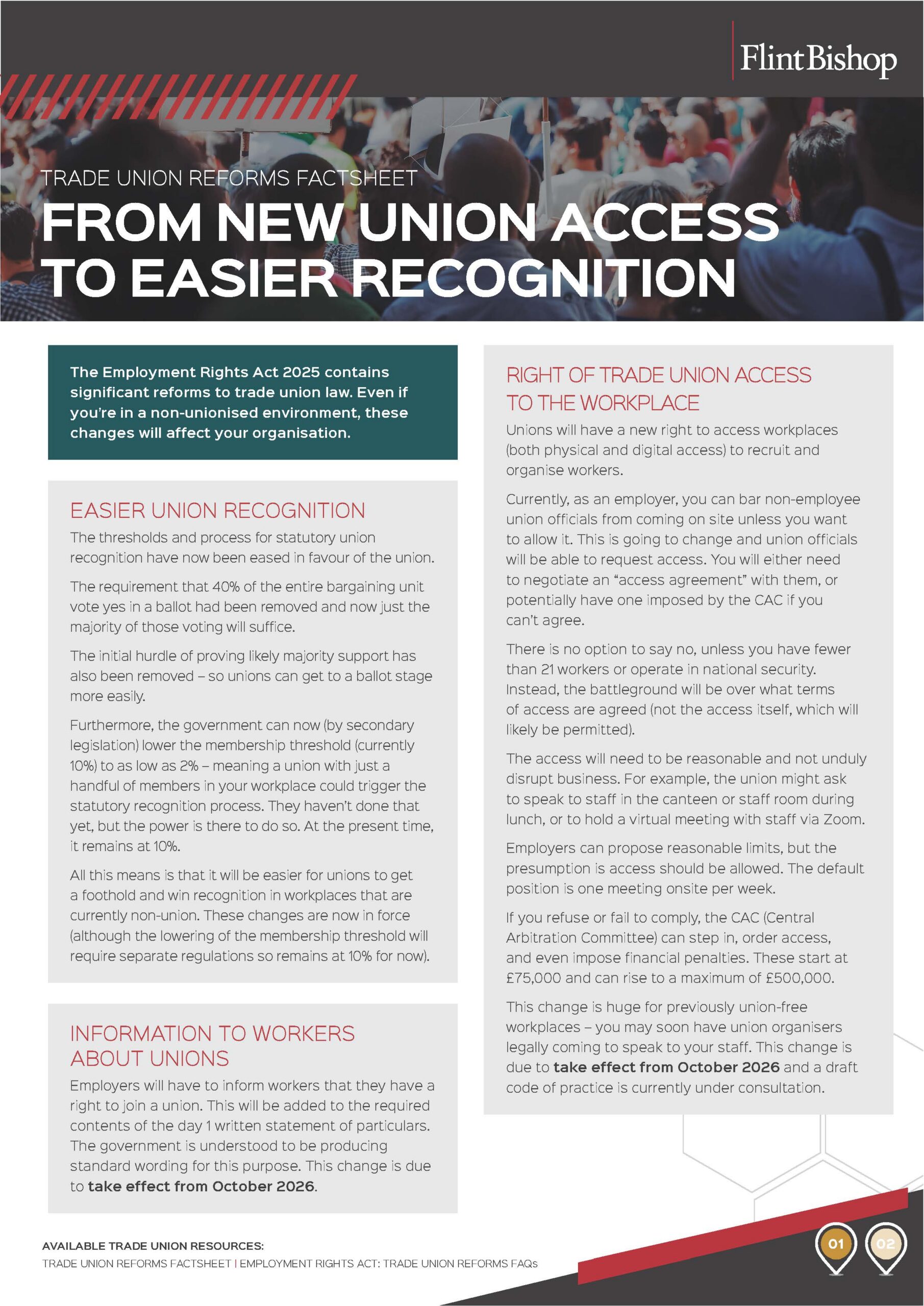
The Employment Rights Act represents one of the most significant reforms to UK employment law in a generation. With legislative changes already underway and further reforms expected throughout 2026 and beyond, employers should begin preparing now, particularly in relation to evolving trade union rights and employer obligations.
To help organisations navigate the changes confidently, our Employment team has created a comprehensive Trade Union Reforms Resource Pack. Bringing together practical guidance and expert insight, this pack is designed to help employers understand what is changing, assess potential risks, and prepare for increased union engagement across the workplace.
Whether your organisation is already unionised or has had limited union interaction historically, these reforms are expected to lower the barriers to union recognition and increase trade union activity across a wide range of sectors.
This resource pack includes two detailed guides designed to provide both strategic insight and practical support.
A concise overview of the key legislative reforms, including:
The factsheet explains how the reforms may affect both unionised and non-unionised organisations and outlines the practical considerations employers should be reviewing now.
A practical Q&A guide addressing common employer concerns, including:
The FAQs provide clear, practical guidance to help employers understand their obligations and respond appropriately as the reforms develop.
These reforms are expected to increase trade union activity across many sectors, making early preparation increasingly important for employers of all sizes.
This resource pack is designed for:
Whether you are reviewing policies, updating internal procedures, preparing managers, or assessing future workforce engagement strategies, this pack provides a practical foundation to help your organisation prepare with confidence.
Get instant access to our Trade Union Reforms Resource Pack and take the first step towards preparing your organisation for the future of employment law.
Our Employment Law team advises employers across the UK on employee relations, workforce strategy, union engagement, workplace policies, and compliance planning.
We are already supporting organisations in preparing for the proposed Employment Rights Act reforms, helping businesses assess risk areas, review internal processes, and respond proactively to legislative change.
If you would like advice on how the proposed trade union reforms could affect your organisation, our team is here to help.
The information contained in this resource pack is provided for general guidance and informational purposes only. It reflects our understanding of the Employment Rights Act and related reforms as at the time of publication, which are subject to change. This content does not constitute legal advice and should not be relied upon as a substitute for obtaining tailored advice specific to your organisation’s circumstances. Professional legal advice should always be sought before taking, or refraining from taking, any action based on this information. While every effort has been made to ensure accuracy, no responsibility is accepted for any loss arising from reliance on this material.

Download our probationary period resource pack to help prepare for the Employment Rights Act changes from January 2027.
Read More
Download our Employment Rights Act Resource Pack to navigate key 2025–2027 employment law changes with expert guidance and practical tools.
Read More
A clear roadmap from our Employment & HR Law team on upcoming Employment Rights Bill changes employers need to prepare for.
Read More
Figures around employee pay and entitlements are a minefield for HR professionals, constantly changing and evolving.
Read More
A guide to help employers remain legally compliant when faced with the difficult scenario of needing to terminate staff on the grounds of redundancy.
Read More
Common contracting issues that should be included as part of any contractual negotiations relating to the transfer of a business or change in service…
Read More